
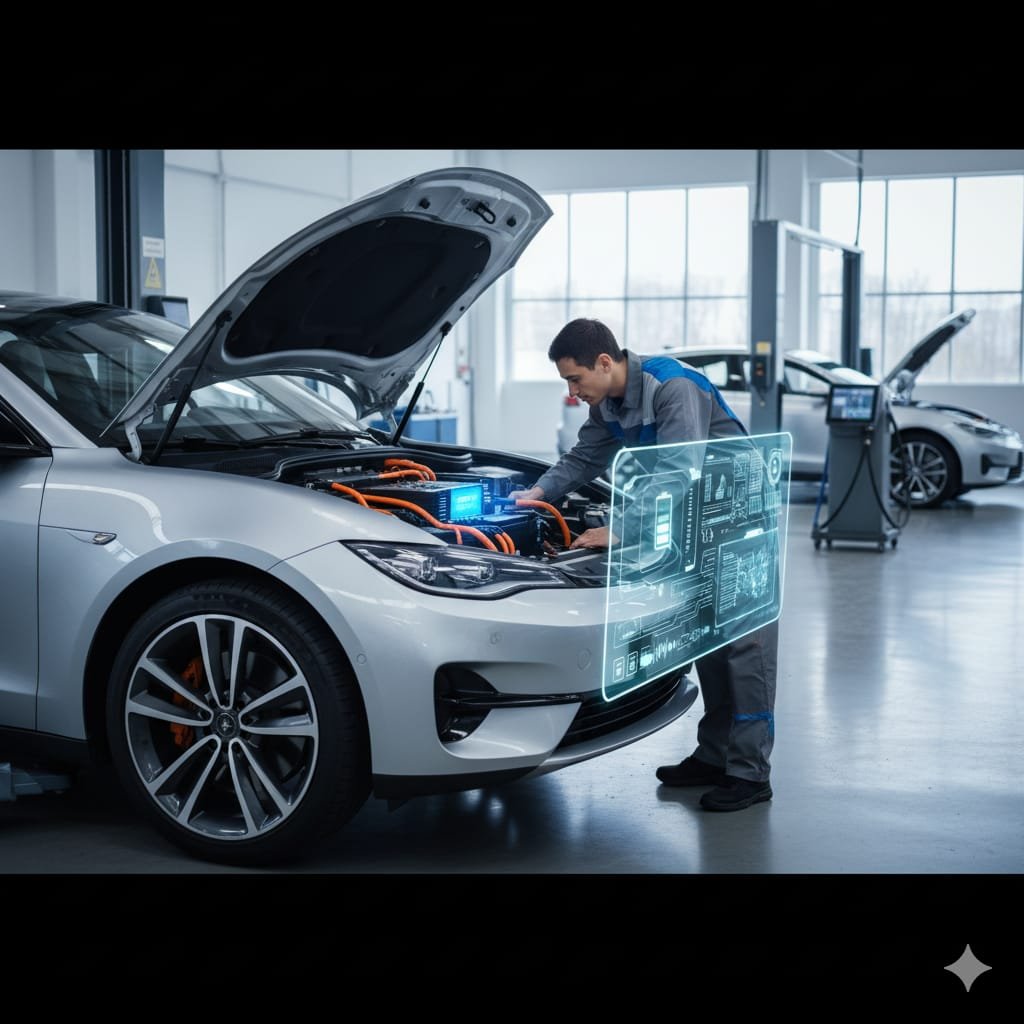
How Electric Car Maintenance Works
For over a century, car ownership has meant a familiar routine of oil changes, spark plug replacements, and mysterious engine noises. But the rise of the electric car (EV) is rewriting the rulebook on vehicle maintenance. The fundamental simplicity of an electric powertrain means that most of the regular, time-consuming, and costly service appointments are now a thing of the past.
So, what does maintenance for an EV actually look like? It’s less about replacing worn-out engine parts and more about managing batteries and software. Let’s explore the four key areas where EV maintenance fundamentally differs from that of a combustion engine car.
The New World of EV Service
1. The Electric Motor: The Definition of Low-Maintenance
The internal combustion engine (ICE) is a complex beast with hundreds of moving parts: pistons, valves, camshafts, belts, and gears, all requiring precise lubrication and timing. In stark contrast, an EV’s electric motor often has only one major moving part: the rotor. There is no oil to change, no spark plugs to wear out, no timing belt to replace, and no exhaust system to rust through.
The Big Difference: The entire concept of a “tune-up” is gone. The electric motor is a sealed unit designed to be essentially maintenance-free for the life of the vehicle. This is the single biggest source of savings and convenience in EV ownership.
2. The Battery Pack: Management, Not Maintenance
The battery is the heart of an EV, and unlike an engine, it doesn’t require regular service. There are no fluid top-ups or part replacements. Instead, “maintenance” is about long-term battery health management, which is largely controlled by your charging habits. To maximize its lifespan, experts recommend keeping the state of charge between 20% and 80% for daily use, avoiding frequent fast charging, and protecting the car from extreme temperatures when possible.
The Big Difference: You don’t “service” the battery, you manage it. While battery degradation is a reality over many years, modern EV batteries are built to last and typically come with a long warranty (often 8 years or 100,000 miles/160,000 km).
3. Regenerative Brakes: Saving Money by Slowing Down
When you lift your foot off the accelerator in an EV, the electric motor reverses its function, acting as a generator to slow the car down and send energy back to the battery. This is called regenerative braking. Because it does a significant portion of the braking work, the traditional physical brake pads and discs are used far less often.
The Big Difference: Your brake pads and discs can last two to three times longer than on a conventional car. This means fewer expensive brake jobs over the life of the vehicle. You’ll still need to have the brake fluid checked and changed periodically, but the wear-and-tear components last much longer.

4. The Cooling System: Simple but Still Important
While an EV doesn’t produce the intense, explosive heat of a combustion engine, its battery and electronics still need to be kept at an optimal operating temperature. EVs have a sophisticated liquid cooling system that circulates coolant through the battery pack and other components. This system is crucial for both performance and battery longevity.
The Big Difference: It’s one of the few systems that feels familiar. Like a traditional radiator, the cooling system is low-maintenance but not zero-maintenance. It will require periodic checks of the coolant level and, according to the manufacturer’s schedule, a fluid flush and replacement every few years.
A Simpler Ownership Experience
Beyond these key areas, the rest of EV maintenance is standard car care: tires, windshield wipers, cabin air filters, and suspension components. The revolutionary change is the elimination of the entire engine and exhaust service ecosystem. This results in significantly lower running costs, fewer trips to the workshop, and a more straightforward and predictable ownership experience. It’s a fundamental shift from reactive repairs to proactive management.
For more in-depth information on automotive technologies, maintenance tips, and vehicle safety, you can refer to trusted sources like MotorTrend, Autocar, and the National Highway Traffic Safety Administration (NHTSA). These resources provide expert insights and up-to-date guidance for car enthusiasts, helping you make informed decisions and stay current with industry developments.